
1. Current knowledge about observed impacts of climate change on the natural and human environment
The Intergovernmental Panel on Climate Change (IPCC) Working Group II 4th Report, Summary for Policy Makers looks at the relationship between climate change and recent observed impacts in the natural and human environment.
Information is based largely on data sets that cover the period since 1970. The number of studies of observed trends in the physical and biological environment and their relationship to regional climate changes has increased greatly since the Third Assessment in 2001. The quality of the data sets has also improved. There is, however, a notable lack of geographic balance in data and literature on observed changes. This means information for developing countries is scarce and as a result the developing countries are not well represented.
The studies contained in the IPCC 4th Report have allowed a broader and more confident assessment of the relationship between measured warming and observed impacts than was made in the Third Assessment. From the current assessment the IPCC has concluded the following:
1. Observational evidence from all continents and most oceans shows that many natural systems are being affected by regional climate changes, particularly the observed impacts of temperature increases.
With regard to changes in snow, ice and frozen ground (including permafrost ), there is high confidence that natural systems are affected. Examples are:
• enlargement and increased numbers of glacial lakes
• increasing ground instability in permafrost regions, and rock avalanches in mountain regions
• changes in some Arctic and Antarctic ecosystems, including those in sea-ice biomes, and also predators high in the food chain
Based on growing evidence, there is high confidence that the following types of hydrological systems are being affected around the world:
• increased run-off and earlier spring peak discharge in many glacier- and snow-fed rivers
• warming of lakes and rivers in many regions, with effects on thermal structure and water quality
There is very high confidence, based on more evidence from a wider range of species, that recent warming is strongly affecting terrestrial biological systems, including such changes as:
• earlier timing of spring events, such as leaf-unfolding, bird migration and egg-laying
• poleward and upward shifts in ranges in plant and animal species (e.g. Quiver Tree in Africa)
Based on satellite observations since the early 1980s, there is high confidence that there has been a trend in many regions towards earlier ‘greening’ of vegetation in the spring linked to longer thermal growing seasons due to recent warming.
The IPCC reports on observed impacts, and there is high confidence, based on substantial new evidence, that observed changes in marine and freshwater biological systems are associated with rising water temperatures, as well as related changes in ice cover, salinity, oxygen levels and circulation. These include:
• shifts in ranges and changes in algal, plankton and fish abundance in high-latitude oceans
• increases in algal and zooplankton abundance in high-latitude and high-altitude lakes
• range changes and earlier migrations of fish in rivers
The uptake of anthropogenic carbon since 1750 has led to the ocean with an average decrease in pH of 0.1 units [IPCC Working Group I Fourth Assessment]. However, the effects of observed ocean acidification on the marine biosphere are as yet undocumented.
2. Observed impacts since 1970 has shown it is likely that anthropogenic warming has had a discernible influence on many physical and biological systems.
Much more evidence has accumulated over the past five years to indicate that changes in many physical and biological systems are linked to anthropogenic warming. From the IPCC observed impacts section, there are four sets of evidence which, taken together, support this conclusion:
1. Information from the IPCC AR4 shows that most of the observed increase in the globally averaged temperature since the mid-20th century is very likely due to the observed increase in anthropogenic greenhouse gas concentrations.
2. Of the more than 29,000 observational data series7, from 75 studies, that show significant change in many physical and biological systems, more than 89% are consistent with the direction of change expected as a response to warming.
3. A global synthesis of studies in this Assessment strongly demonstrates that the spatial agreement between regions of significant warming across the globe and the locations of significant observed changes in many systems consistent with warming is very unlikely to be due solely to natural variability of temperatures or natural variability of the systems.
4. Finally, there have been several modelling studies that have linked responses in some physical and biological systems to anthropogenic warming by comparing observed responses in these systems with modelled responses in which the natural forcings (solar activity and volcanoes) and anthropogenic forcings (greenhouse gases and aerosols) are explicitly separated. Models with combined natural and anthropogenic forcings simulate observed responses significantly better than models with natural forcing only.
Limitations and gaps in the IPCC 4th Report Climate Change Impacts Adaptation and Vulnerability prevent more complete attribution of the causes of observed system responses to anthropogenic warming. First, the available analyses are limited in the number of systems and locations of observed impacts.
Second, natural temperature variability is larger at the regional than the global scale, thus affecting identification of changes due to external forcing. Finally, at the regional scale other factors (such as land-use change, pollution, and invasive species) are influential.
Nevertheless, the consistency between observed impacts and modelled changes in several studies and the spatial agreement between significant regional warming and consistent impacts at the global scale is sufficient to conclude with high confidence that anthropogenic warming over the last three decades has had a discernible influence on many physical and biological systems.
3. Other effects of regional climate changes on natural and human environments are emerging, although many are difficult to discern due to adaptation and non-climatic drivers.
Effects of temperature increases have been documented in the following systems:
• effects on agricultural and forestry management at Northern Hemisphere higher latitudes, such as earlier spring planting of crops, and alterations in disturbance regimes of forests due to fires and pests;
• some aspects of human health, such as heat-related mortality in Europe, infectious disease vectors in some areas, and allergenic pollen in Northern Hemisphere high and mid-latitudes;
• some human activities in the Arctic (e.g., hunting and travel over snow and ice) and in lower elevation alpine areas (such as mountain sports, e.g., skiing in the Alps and Andes ).
Recent climate changes and climate variations are beginning to have effects on many other natural and human systems. However, based on the published literature, the observed impacts have not yet become established trends. Examples include:
• Settlements in mountain regions are at enhanced risk to glacier lake outburst floods caused by melting glaciers. Governmental institutions in some places have begun to respond by building dams and drainage works.
• In the Sahelian region of Africa, warmer and drier conditions have led to a reduced length of growing season with detrimental effects on crops. In southern Africa, longer dry seasons and more uncertain rainfall are prompting adaptation measures.
• Sea-level rise and human development are together contributing to losses of coastal wetlands and mangroves and increasing damage from coastal flooding in many areas.
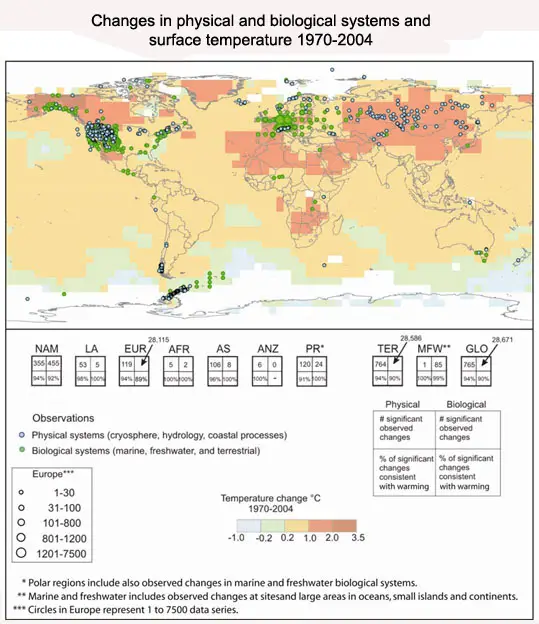
IPCC Observed Impacts – Figure Above. Locations of significant changes in observations of physical systems (snow, ice and frozen ground; hydrology; and coastal processes) and biological systems (terrestrial, marine, and freshwater biological systems), are shown together with surface air temperature changes over the period 1970-2004. A subset of about 29,000 data series was selected from about 80,000 data series from 577 studies. These met the following criteria: (1) Ending in 1990 or later; (2) spanning a period of at least 20 years; and (3) showing a significant change in either direction, as assessed in individual studies. These data series are from about 75 studies (of which ~70 are new since the Third Assessment) and contain about 29,000 data series, of which about 28,000 are from European studies. White areas do not contain sufficient observational climate data to estimate a temperature trend. The 2 x 2 boxes show the total number of data series with significant changes (top row) and the percentage of those consistent with warming (bottom row) for (i) continental regions: North America (NAM), Latin America (LA), Europe (EUR), Africa (AFR), Asia (AS), Australia and New Zealand (ANZ), and Polar Regions (PR) and (ii) global-scale: Terrestrial (TER), Marine and Freshwater (MFW), and Global (GLO).