
Tidal power is a means of electricity generation achieved by capturing the energy contained in moving water mass due to tides. Two types of energy can be extracted: kinetic energy of currents between ebbing and surging, and potential energy from the difference in height (or head) between high and low water marks.
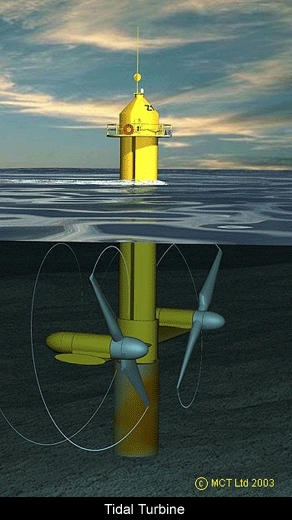
The MCT Turbine seen below is a new design, generating energy from flowing currents and is considered more feasible today than building ocean based dams or barrages. Many coastal sites worldwide are being examined for their suitability to produce energy from these currents.
These turbines could be installed in the sea at places with high current velocities, or in a few places with fast enough continuous ocean currents, to take out energy from these huge volumes of flowing water.
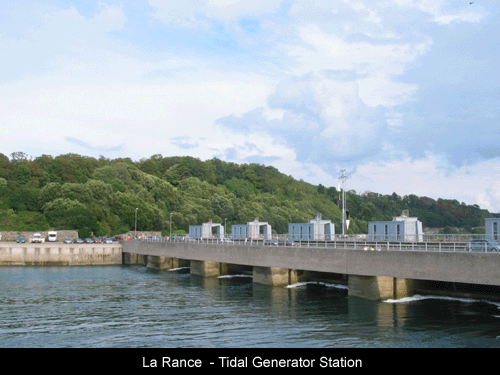
There is little doubt that the energy potential of tides is huge. The largest power plant is the La Rance station in France which generates a whopping 240 megawatts (MW)of power. The idea of constructing a power plant on the La Rance dates to Gerard Boisnoer in 1921. The site was attractive because there is a large average range between low and high levels (8 metres, with a maximum equinoctial range of 13.5 metres).
In spite of the high cost of the La Rance project, the plant’s costs have now been recovered, and electricity production costs are lower than for nuclear power generation. (18 Euro cents per kWh, versus 25 per kWh for nuclear). However, the barrage has caused progressive silting of the Rance ecosystem. Sand-eels and Plaice have disappeared, though Sea bass and cuttlefish have returned to the river. There are only two other plants operating worldwide, one being the 20MW Annapolis station in Nova Scotia, and a small 0.5MW plant in Russia.
Tidal power schemes do not produce energy 24 hours a day. A conventional design, in any mode of operation, would produce power for 6 to 12 hours in every 24 and will not produce power at other times. As the tidal cycle is based on the period of rotation of the Moon (24.8 hours) and the demand for electricity is based on the period of rotation of the earth (24 hours), the energy production cycle will not always be in phase with the demand cycle. This causes problems for the electric power transmission grid, as capacity with short starting and stopping times (such as hydropower or gas fired power plants) will have to be available to alternate power production with these power schemes.
The less intrusive plants utilising kinetic energy from current flow rather than potential energy of barrage dams would appear to be more environmentally friendly and sustainable in the long term.
What Other Visitors Have Said
Click below to see contributions from other visitors to this page…
Triple Threat Design 
Put wind turbines on top of the tidal turbines and coat the outside of the turbine in solar panels.
This would maximise energy in minimal space.
Let …
Tidal Power – Marine Current Turbines
I don’t live anywhere near the sea, but the power of the tides is simply awesome! And tidal power can provide huge reductions in greenhouse gas emissions….
South Korean Tidal Power 
South Korea are looking at building a power plant with a capacity of 240-260 mega watt at the entrance to Lake Sihwa by 2009 at a cost of about US$400 …
Cost?!?!?!?!?!
Tidal power or tidal energy barrage costs about 15 billion to 4.5 billion dollars to build a station.
The Cost. Not rated yet
Well the cost itself is downright sick, but it would payoff in the long run. The way I see it, there should be one build all over the world (in appropriate …
Smart Grid Not rated yet
Building from Triple Threat…I agree. On top of that, a smart grid is needed. B/c wind/tidal/solar don’t produce a steady stream of power generation …
No Tidal! Not rated yet
I dont like tidal power in the least bit!
No Tidal! Not rated yet
I dont like tidal power in the least bit!
Stop Not rated yet
Stop with all of the building bridges to keep the water out. We need water everyday and we need to have fish for food and we need all of these things and …
Cost of Tidal Power Not rated yet
Tidal power is awesome but I was wondering how many US cents it cost per kwh?
Extreme Costs? Not rated yet
I think tidal power is a great idea. How much does an average plant cost to make in U.S or Canadian dollars?
Tidal Not rated yet
My take on tidal power is that is is probably one of the best ind of alternative resources we can use to produce things such as electricity because it uses …
Old School Crossed With New Not rated yet
Since at least 1958, man has been harnessing the power of tides to produce electricity. But harnessing tide power has been ongoing since prehistoric times….