Solar thermal energy harnesses sun power for the purposes of heating and electricity generation. Thermal collectors are commonly used to generate hot water from the sun for domestic and light industrial applications.
A typical residential solar hot water system using the sun reduces the need for conventional water heating by about two-thirds. It minimizes the expense of electricity or fossil fuel to heat the water therefore reducing greenhouse gas emissions.
Perhaps you would like to build your own? Using the sun to heat water is under-utilised and a great deal of coal-fired electricity could be saved by using simple heating devices. For instance, there are simple plans available to cheaply heat swimming pools. No special tools or skills are required to build a solar pool heater.
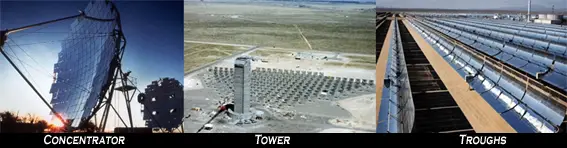
Power plants use the sun to generate electricity by converting energy to heat to drive a thermal power plant. Heat from the sun can be collected in various ways, such as parabolic troughs and dishes or central towers.
A parabolic trough consists of curved mirrors forming troughs that focus the sun’s energy on a pipe. A fluid, typically oil, is circulated through the pipes, which is then used to drive a conventional generator to create electricity.
A parabolic dish consists of a parabolic-shaped concentrator (similar in shape to a satellite dish) that reflects radiation onto a receiver mounted at the focal point at the centre. The heat collected is used by a heat engine, which generates electricity.
Central receivers, sometimes called “Power Towers” consist of a tower surrounded by a large array of heliostats. Heliostats are mirrors that track the sun and reflect its rays onto the receiver, which absorbs the heat energy and drives a turbine to generate electricity.