
Soil efflux measurements can be made in areas where volcanic gases, typically CO2, rise from depth and discharge into the soil just beneath the surface. Because the gases escape from the ground over a broad area, a small accumulation chamber must be used to collect and measure the gas at dozens to hundreds of separate sites in order to calculate the total soil efflux of gas.
The USGS advises that, soon after a batch of magma rose beneath Mammoth Mountain, California to within a few kilometres of the surface in 1989-90, several zones of high CO2 soil efflux developed around the volcano. To determine the extent and amount of CO2 gas escaping from the soil, scientists over a period of years, made thousands of soil efflux measurements in the area.
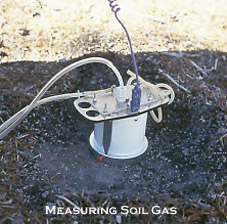 To measure the rate at which these gases are released into the atmosphere, an accumulation chamber (image on right) is placed on the soil surface and connected to an infrared CO2 analyser. As the gas enters the chamber from the soil, the LI-COR analyser then records the increasing concentration of CO2 gas in the chamber. The rate of increase of CO2 in the chamber is then used along with ambient temperature, pressure, and other parameters to calculate a soil CO2 efflux for that location. The measuring apparatus is then moved to other nearby locations and additional efflux values are measured.
If enough points are measured, a map of the soil CO2 anomaly can be constructed and a total gas emission can be calculated. Although individual measurements can be influenced by soil and meteorological conditions, such soil gas surveys, if repeated often enough, can provide insight into any trends that may develop.
Information for this page was sourced from the USGS web site, Measuring volcanic gases: soil efflux.