The pyrheliometer is a broadband instrument that measures the direct(or beam) component of solar radiation at normal incidence. This means the instrument is always aimed directly at the sun, via a tracking mechanism that continuously follows the sun. It is sensitive to wavelengths in the band from 280 to 3000 nm.
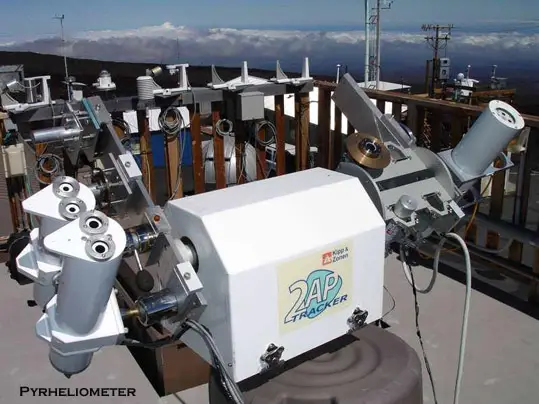
Solar irradiance enters the instrument through a sealed crystal-quartz window and the sunlight is directed onto a thermopile which converts heat to an electrical signal that can be recorded. A calibration factor is applied when converting the millivolt signal to an equivalent radiant energy flux, measured in watts per square meter.
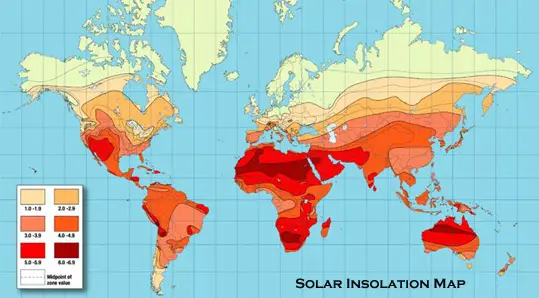
This sort of information is used to build up Insolation maps. Insolation (from Incoming Solar radiation) is a measure of solar energy received on a given surface area in a given time, and as seen in the map below, varies around the Globe. Knowing what the insolation factor is for a particular region is useful when setting up solar panels. When readings are compared over time they also contribute to our understanding of climatic changes.