
Hurricanes are similar to cyclones, containing and releasing enough energy to supply electricity to the US for one year. They can carry the ocean along with them, bringing storm surges as high as 7.6 m (25 ft) above sea level. Often storm surges and associated floods are responsible for much of the damage to coastal areas.
Towers in the Tempest – This visualization won Honorable Mention in the National Science Foundation’s Science and Engineering Visualization Challenge in September 2007.
‘Towers in the Tempest’ is a 4.5 minute narrated animation that explains recent scientific insights into how hurricanes intensify. This intensification can be caused by a phenomenon called a ‘hot tower’. For the first time, research meteorologists have run complex simulations using a very fine temporal resolution of 3 minutes. Combining this simulation data with satellite observations enables detailed study of ‘hot towers’. The science of ‘hot towers’ is described using: observed hurricane data from a satellite, descriptive illustrations, and volumetric visualizations of simulation data.
Source: NASA/Goddard Space Flight Center Scientific Visualization Studio
Destruction
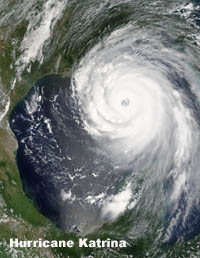
As the spinning storm moves across the ocean and unstopped by land, wind speeds increase by many hundreds of kilometers per hour. These severe storms are commonly classified by the strength of their winds into five categories on the Saffir-Simpson Intensity Scale. The weakest, with wind speeds of 119-153 kph (74-95 mph), are referred to as Category I storms and cause minimal damage primarily to plants and trees. Category V storms, such as Camille in 1969, are the strongest and responsible for catastrophic damage and had sustained winds of more than 320 kph (200 mph). Camille, was the most powerful ever recorded that hit the northern gulf coast in 1992, while Andrew, was a Category IV storm with sustained wind speeds of 225 kph (140 mph). Katrina was the most recent storm to cause considerable damage to New Orleans in October 2005.
Storms pursue unpredictable paths toward land. There is no set pattern in the path from their birth place in the Atlantic Ocean, although they frequently move north-westerly to the Gulf of Mexico and eastern coasts of North and Central America. These storm fronts can also give rise to tornadoes.