

THIS ARTICLE – DON’T BURN FOOD WAS EMAILED FROM AVAAZ.org
Avaaz.org is an independent, not-for-profit global campaigning organization that works to ensure that the views and values of the world’s people inform global decision-making. (Avaaz means “voice” in many languages.) Avaaz receives no money from governments or corporations, and is staffed by a global team based in London, Rio de Janeiro, New York, Paris, Washington DC, and Geneva.
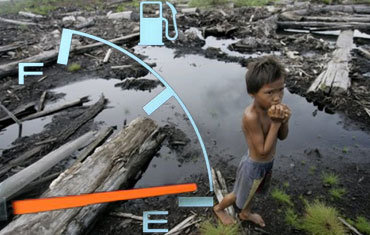
Don’t burn food: biofuels standards now!
Each day, 820 million people in the developing world do not have enough food to eat1. Food prices around the world are shooting up, sparking food riots from Mexico2 to Morocco3. And the World Food Program warned last week that rapidly rising costs are endangering emergency food supplies for the world’s worst-off4.
How are the wealthiest countries responding? They’re burning food.
Specifically, they’re using more and more biofuels–alcohol made from plant products, used in place of petrol to fuel cars. Biofuels are billed as a way to slow down climate change. But in reality, because so much land is being cleared to grow them, most biofuels today are causing more global warming emissions than they prevent5, even as they push the price of corn, wheat, and other foods out of reach for millions of people6.
Not all biofuels are bad–but without tough global standards, the biofuels boom will further undermine food security and worsen global warming. Click here to use our simple tool to send a message to your head of state before this weekend’s global summit on climate change in Chiba, Japan, and help build a global call for biofuels regulation:
Don’t burn food – Biofuel Standards (at avaaz.org)
Sometimes the trade-off is stark: filling the tank of an SUV with ethanol requires enough corn to feed a person for a year7. But not all biofuels are bad; making ethanol from Brazilian sugar cane is vastly more efficient than US-grown corn, for example, and green technology for making fuel from waste is improving rapidly.
The problem is that the EU and the US have set targets for increasing the use of biofuels without sorting the good from the bad. As a result, rainforests are being cleared in Indonesia to grow palm oil for European biodiesel refineries, and global grain reserves are running dangerously low. Meanwhile, rich-country politicians can look “green” without asking their citizens to conserve energy, and agribusiness giants are cashing in. And if nothing changes, the situation will only get worse.
What’s needed are strong global standards that encourage better biofuels and shut down the trade in bad ones. Such standards are under development by a number of coalitions8, but they will only become mandatory if there’s a big enough public outcry. It’s time to move: this Friday through Saturday, the twenty countries with the biggest economies, responsible for more than 75% of the world’s carbon emissions9, will meet in Chiba, Japan to begin the G8’s climate change discussions. Before the summit, let’s raise a global cry for change on biofuels:
Don’t burn food – Biofuel Standards (at avaaz.org)
A call for change before this week’s summit won’t end the food crisis, or stop global warming. But it’s a critical first step. By confronting false solutions and demanding real ones, we can show our leaders that we want to do the right thing, not the easy thing.
As Kate, an Avaaz member in Colorado, wrote about biofuels, “Turning food into oil when people are already starving? My car isn’t more important than someone’s hungry child.”
It’s time to put the life of our fellow people, and our planet, above the politics and profits that too often drive international decision-making. This will be a long fight. But it’s one that we join eagerly–because the stakes are too high to do anything else.
With hope,
Ben, Ricken, Iain, Galit, Paul, Graziela, Pascal, Esra’a, Milena — the Avaaz.org team
The article, Don’t burn food: biofuels standards now! was written by the Avaaz.org team.
SOURCES:
[1] World Food Programme. “Hunger Facts.” Accessed 10 March 2008.
[2] The Sunday Herald (Scotland). “2008: The year of global food crisis.” 9 March 2008.
[3] The Australian: “Biofuels threaten ‘billions of lives‘” 28 February, 2008.
[4] AFP: “WFP chief warns EU about biofuels.” 7 March 2008.
[5] New York Times: “Biofuels Deemed a Greenhouse Threat.” 8 February 2008.
[6] The Times: “Rush for biofuels threatens starvation on a global scale.” 7 March 2008. … also see BBC: “In graphics: World warned on food price spiral.” 10 March 2008.
[7] The Economist: “The end of cheap food.” 6 December 2007.
[8] See http://www.globalbioenergy.org, http://cgse.epfl.ch/page70341.html, and http://www.timesonline.co.uk/tol/news/environment/article3489640.ece.
[9] Government of Japan. “Percentage of global carbon dioxide emissions (FY 2003) contributed by G20 nations.”
———————————-
|
Biomass Technologies
Landfill Gas What is Biofuel? Palm Oil Biodiesel Biodiesel from Algae Biodiesel from Tallow Ethanol Biofuel Wood Gas Generator Ethics of Biofuel
|